

On July 4, 2025, a previously unknown entity, “HonestAGI,” launched an information operation. The first strategic decision was revealing: instead of using a Chinese open-source community like Gitee, they chose the American-based GitHub repository as their platform. The primary vehicle was a research paper titled, “Intrinsic Fingerprint of LLMs: Continue Training is NOT All You Need to Steal A Model!”. The paper’s central claim was the discovery of an “extraordinary correlation” between Huawei’s newly open-sourced Pangu Pro MoE model and Alibaba’s Qwen 2.5 model, alleging that Huawei’s model was a derivative work obtained through plagiarism.
The timing was precise. The attack was launched within days of Huawei’s major Pangu Models 5.5 unveiling at its developer conference (June 20) and the subsequent open-sourcing of the Pangu Pro model (June 30). HonestAGI’s stated methodology involved creating “intrinsic fingerprints” of large language models (LLMs), a novel approach designed to lend the claims a veneer of technical authority.
A forensic review of the operation reveals two critical failures that invalidate its claims and expose its fraudulent nature.
First, the methodology itself is fundamentally flawed. Huawei’s Noah’s Ark Lab conducted a simple control experiment, applying HonestAGI’s “fingerprinting” technique to verifiably unrelated models—Deepseek and Llama2. The result was a similarity score of 0.91, nearly identical to the 0.927 score used to indict Pangu. This demonstrates that the high correlation is an artifact of the method’s reaction to common transformer architectures and training parameters, not an indicator of plagiarism. The methodology is, therefore, unscientific and unfit for its stated purpose.
Second is the evidence of more deliberate academic fraud. The HonestAGI paper contained fabricated citations including references to non-existent publications with fake arXiv IDs (e.g., “arXiv:2210.01234”). The paper’s authors—listed as Do-hyeon Yoon, Minsoo Chun, Thomas Allen, Hans Müller, Min Wang, and Rajesh Sharma under the banner of the “Honest AGI Community”—possess no discernible academic history, no discoverable Google Scholar profiles, and are linked to suspicious email addresses and the paper’s writing style is consistent with AI-generated text.
Faced with the rapid exposure of its fraudulent methods and citations by the open-source community, the operational lifecycle of this campaign was predictably short.
- July 4: HonestAGI publishes allegations.
- July 5: Huawei publicly dismantles the methodology.
- July 6: The community exposes the fabricated references.
- July 6: The entire GitHub repository and its contents are deleted.
In what appears to be a subcontracted media hit, Yahoo Finance recently published an article recycling the already-disproven Pangu 5.5 plagiarism narrative under the headline “Huawei’s AI Scandal Just Exploded.”
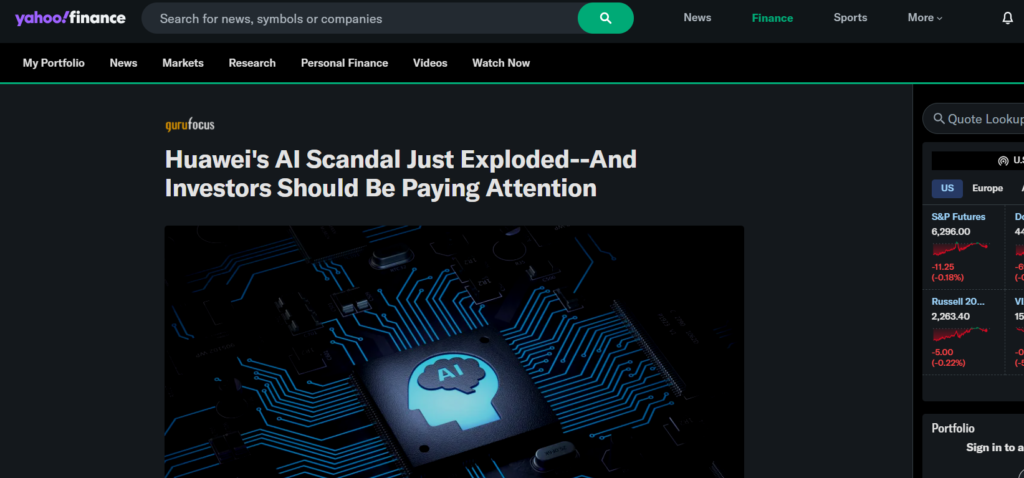
The headline says that “Investors Should Be Paying Attention,” yet Huawei is a privately owned company whose shares are held by its employees. So, what exactly are they supposed to do? Panic-sell their stock to the guy at the next desk in the cafeteria?
You have to wonder who paid for this garbage. They have no idea what they’re even attacking anymore.
This pathetic attempt at a scandal tells us that the West’s ultimate weapon against a corporation is to threaten its stock price. Huawei’s private, employee-owned structure is a geopolitical superpower. It makes the company almost completely immune to the stock market panics, short-seller attacks, and shareholder activism that are routinely used to discipline or destroy Western firms.
In the end, the only “investors” who ended up “paying attention” were the ones who got paid to publish the article in the first place.